The Roland Jupiter-08 isn’t the analog Jupiter reissue many had hoped for. Still, it’s much more than just a facelift of the JP-08 from the first Boutique series. Find out more in our review!
Roland Jupiter-08: Key Features at a Glance
- Second Jupiter-8 emulation in the compact Boutique series
- Closer to the Jupiter-8 in design than the JP-08
- Includes K-25m keyboard dock
- Up to 32 voices of polyphony
- Polyphonic step sequencer and arpeggiator
- 17 built-in effects
Roland Jupiter-08 Review
Roland Jupiter-08: First Impressions
Released 45 years after the legendary Jupiter-8, the new Roland Jupiter-08 has some big footsteps to fill. After the JP-08, which came out back in 2015, it marks the second Jupiter reissue in the cute and compact Boutique Series. Compared to its predecessor, the new one sports a fresh design, expanded polyphony, an improved sound engine, a polyphonic sequencer, and built-in effects. Sounds like a winner—yet it didn’t completely win me over. I’ll tell you why in this review.
The Roland Jupiter-08 is now available from our affiliate partners Thomann* and Sweetwater*.


Roland Jupiter-08: Not a Reissue of the JP-08
45 years ago, Roland released the Jupiter-8, one of the most iconic synths of all time. In celebration of this anniversary, the manufacturer’s most famous synth is now getting yet another reissue in the compact Boutique series. I was excited to be given the opportunity to try out the Roland Jupiter-08 in my studio.
The Jupiter-08 isn’t the first of its kind. Back in 2015 (hard to believe it’s been that long!), Roland launched the JP-08 as one of its first three Boutique synths, marking the beginning of a new series that continues to this day. However, the JP-08 was quite limited in its capabilities, as it offered a measly four voices—half the voice count of the analog original. It’s also been unavailable for quite some time now.
Ever since Roland caused a sensation with the TR-1000, many fans have been wondering whether the Japanese manufacturer might also be working on a new analog synth. The mighty Jupiter-8 is certainly one of the most requested reissues—especially since Behringer hasn’t yet managed to bring the JT-16 to market.
If you’ve been hoping for an analog Jupiter reissue, you’ll likely be disappointed that the new Jupiter-08 is just as digital as its predecessor. That said, it’s still a lot more than just a redesigned JP-08. In terms of capabilities and especially polyphony, it clearly leaves its rather limited forerunner in the dust.
Look, a Baby Jupiter!
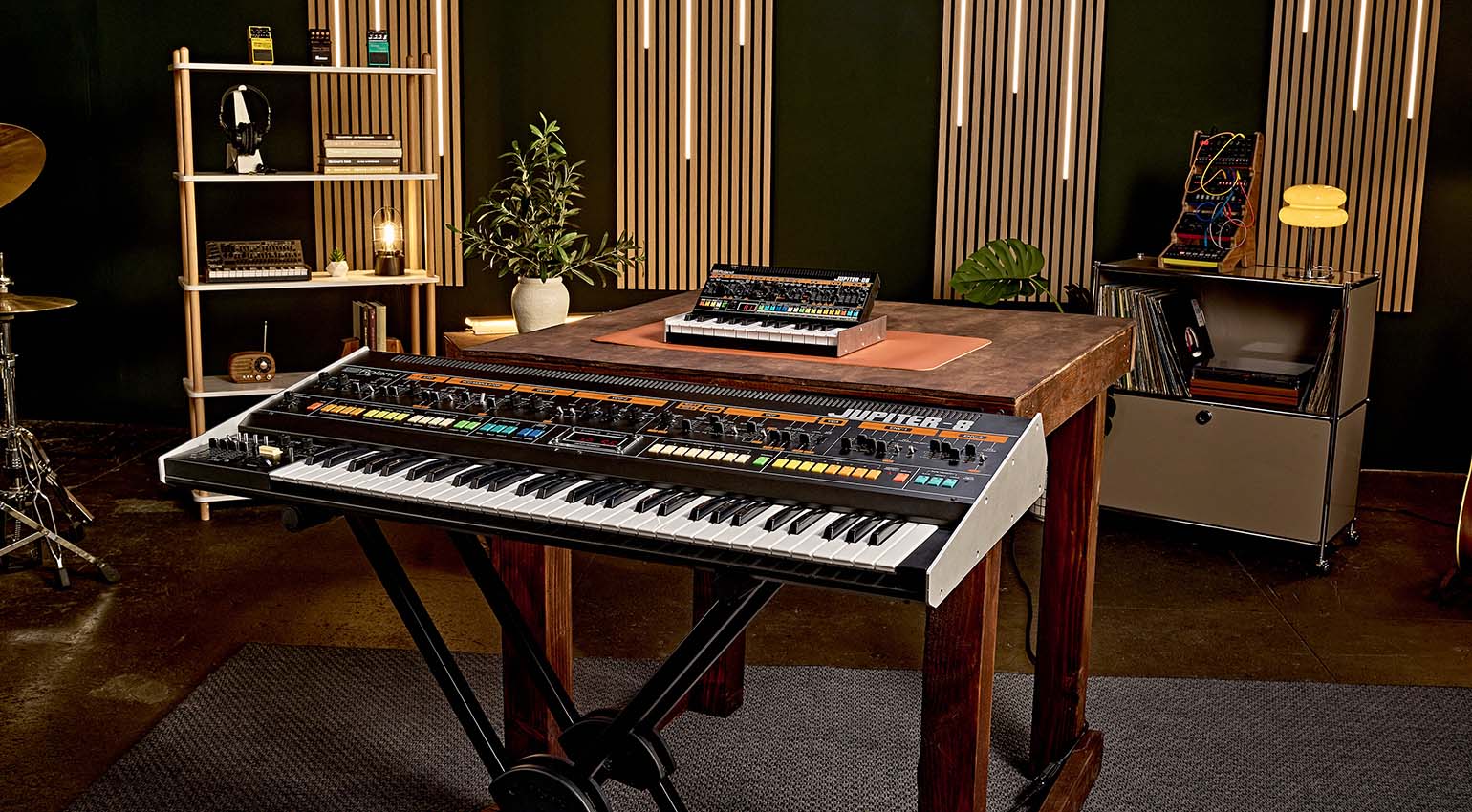
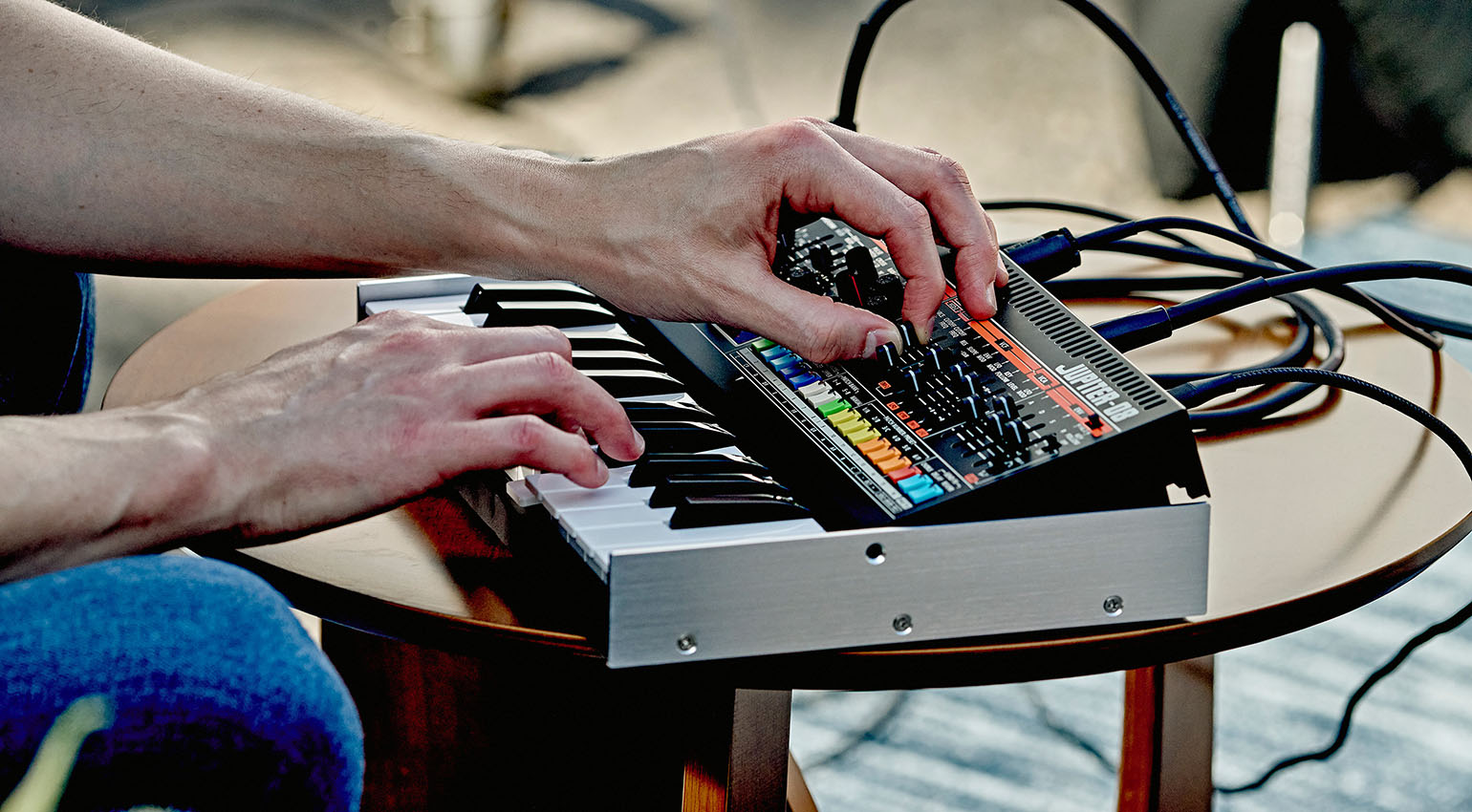
What it does have in common with the JP-08, however, is the tiny size. Like the entire Boutique series, it looks downright cute—a bit like a Jupiter for a dollhouse. The short sliders and tiny knobs definitely require a delicate touch. But this goes for the entire series, and I’ll leave it up to you to decide whether you’re a fan of this format or not.
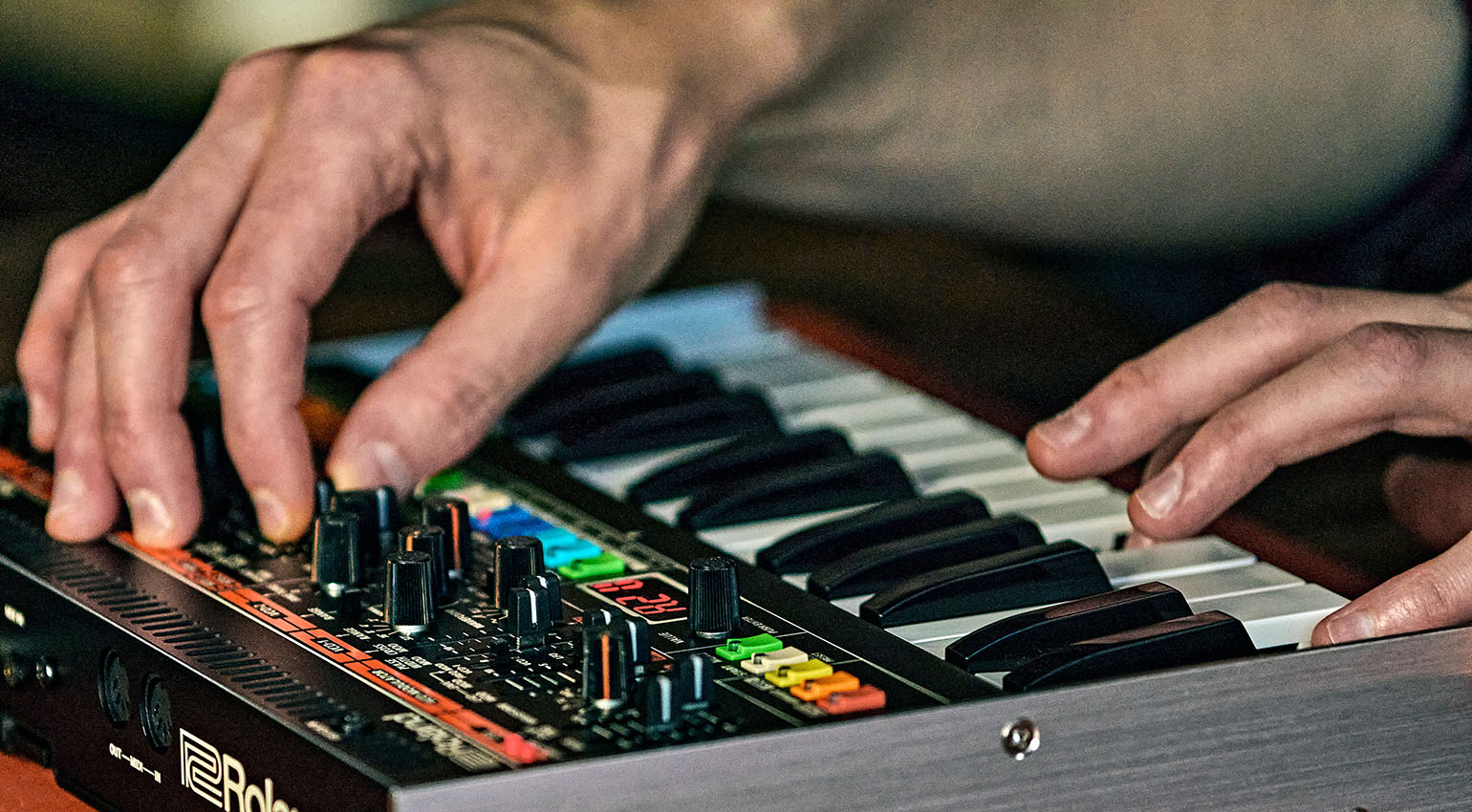
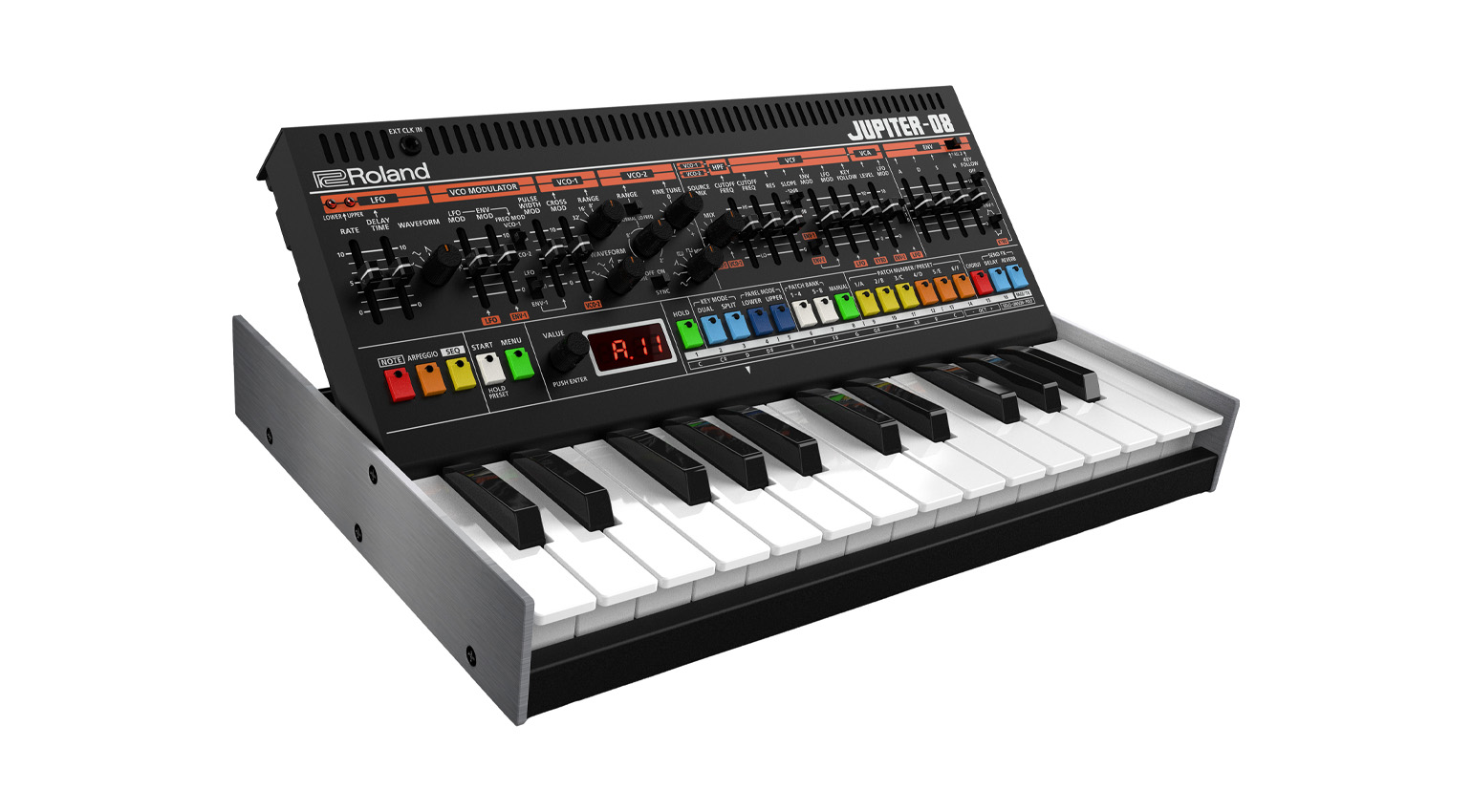
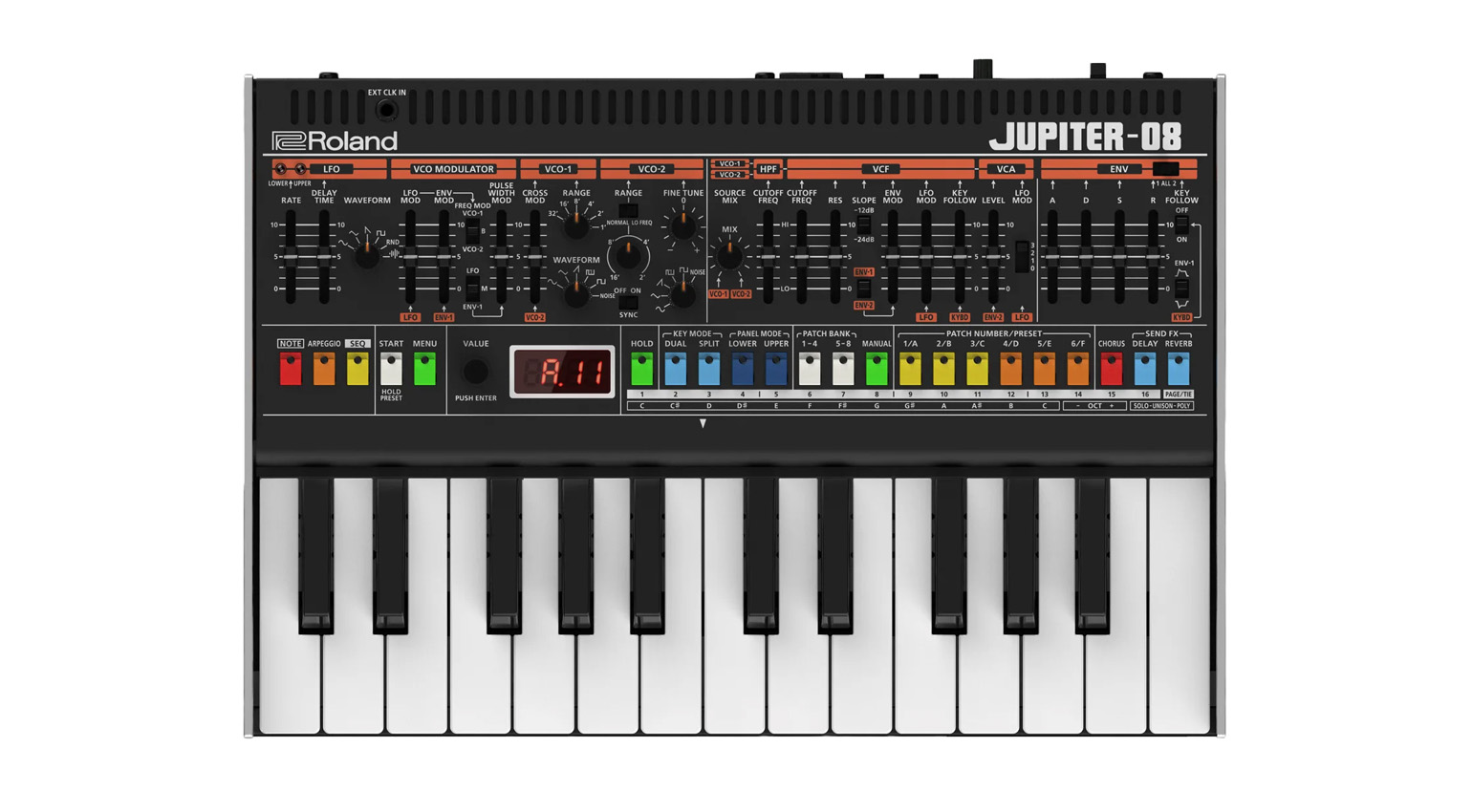
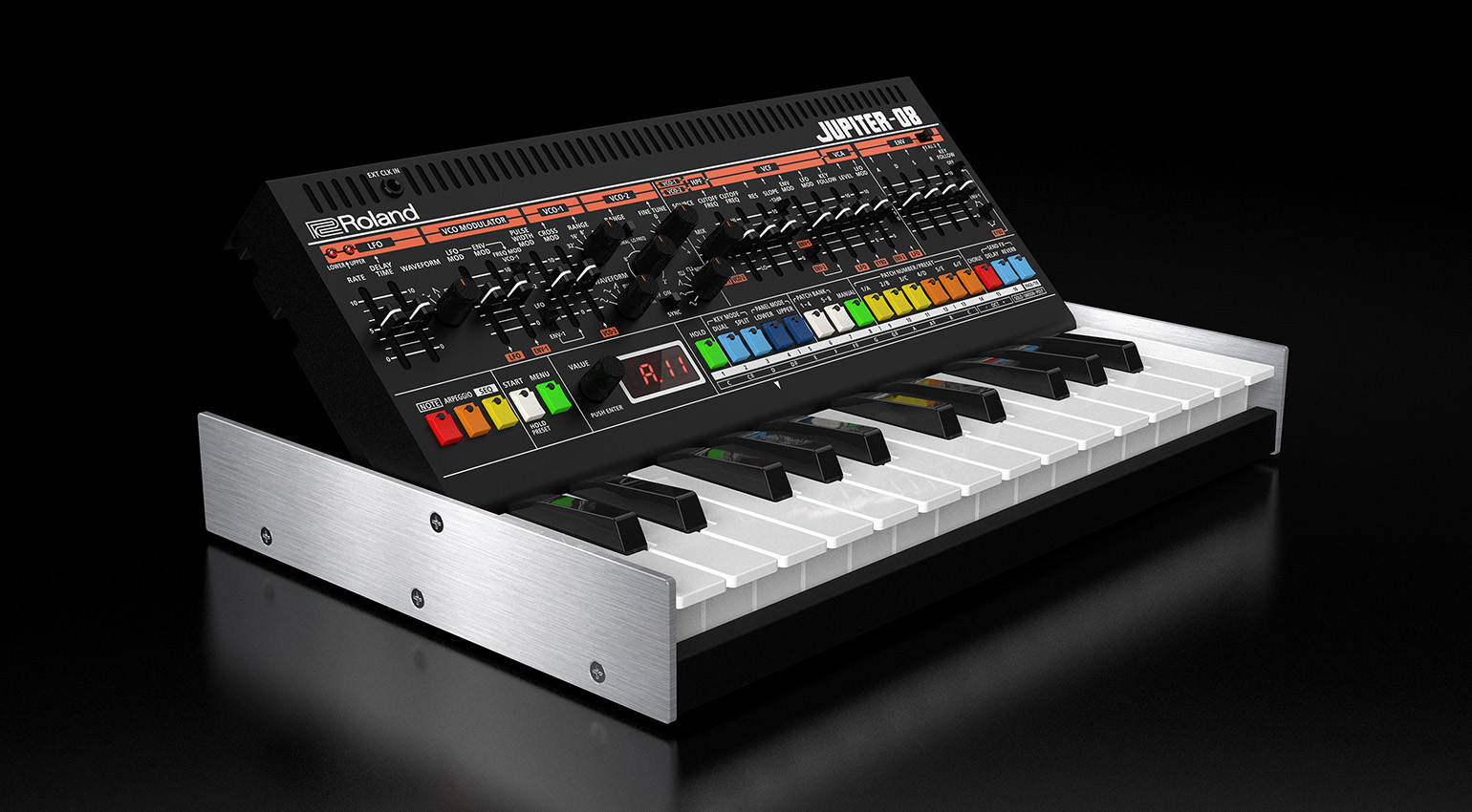
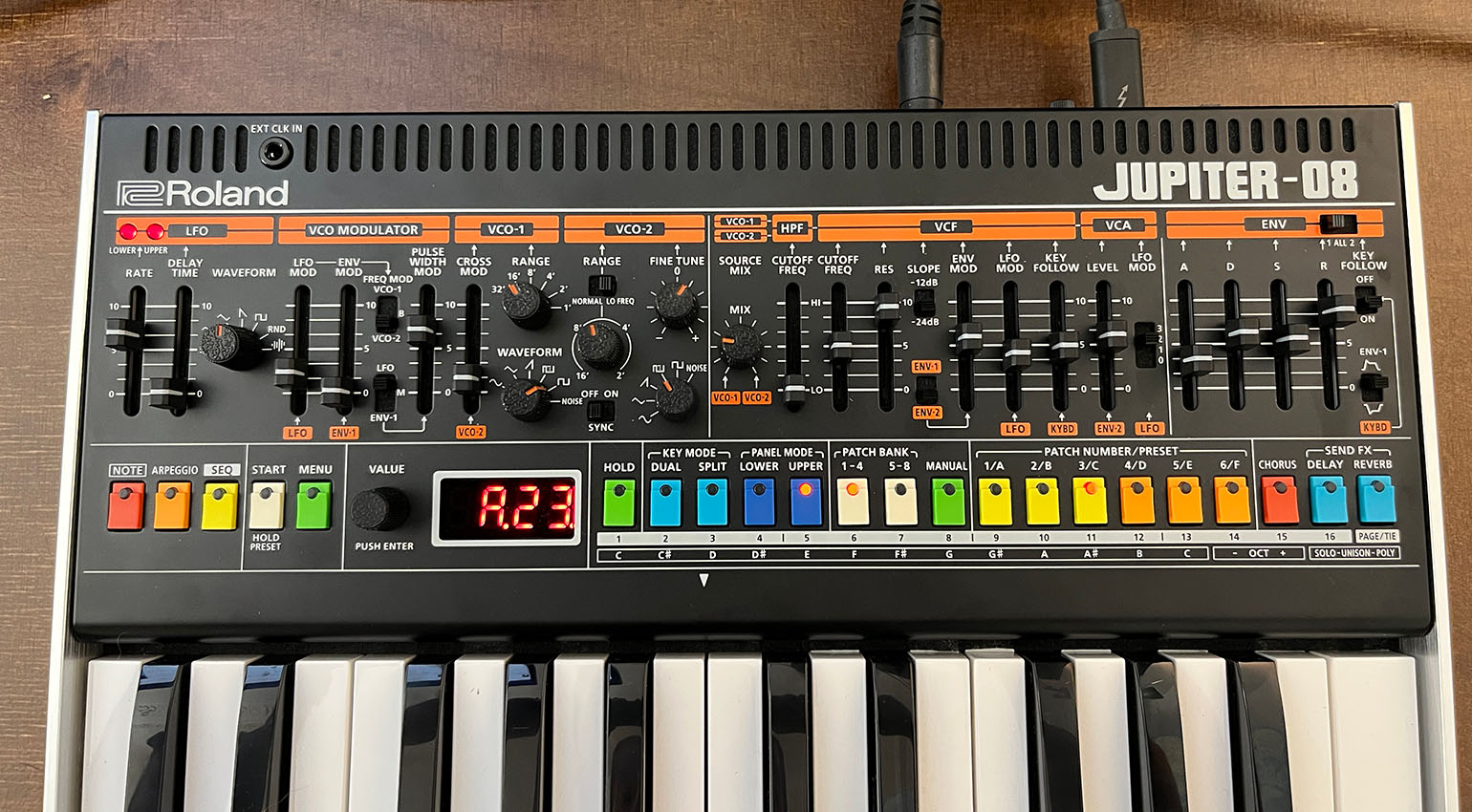
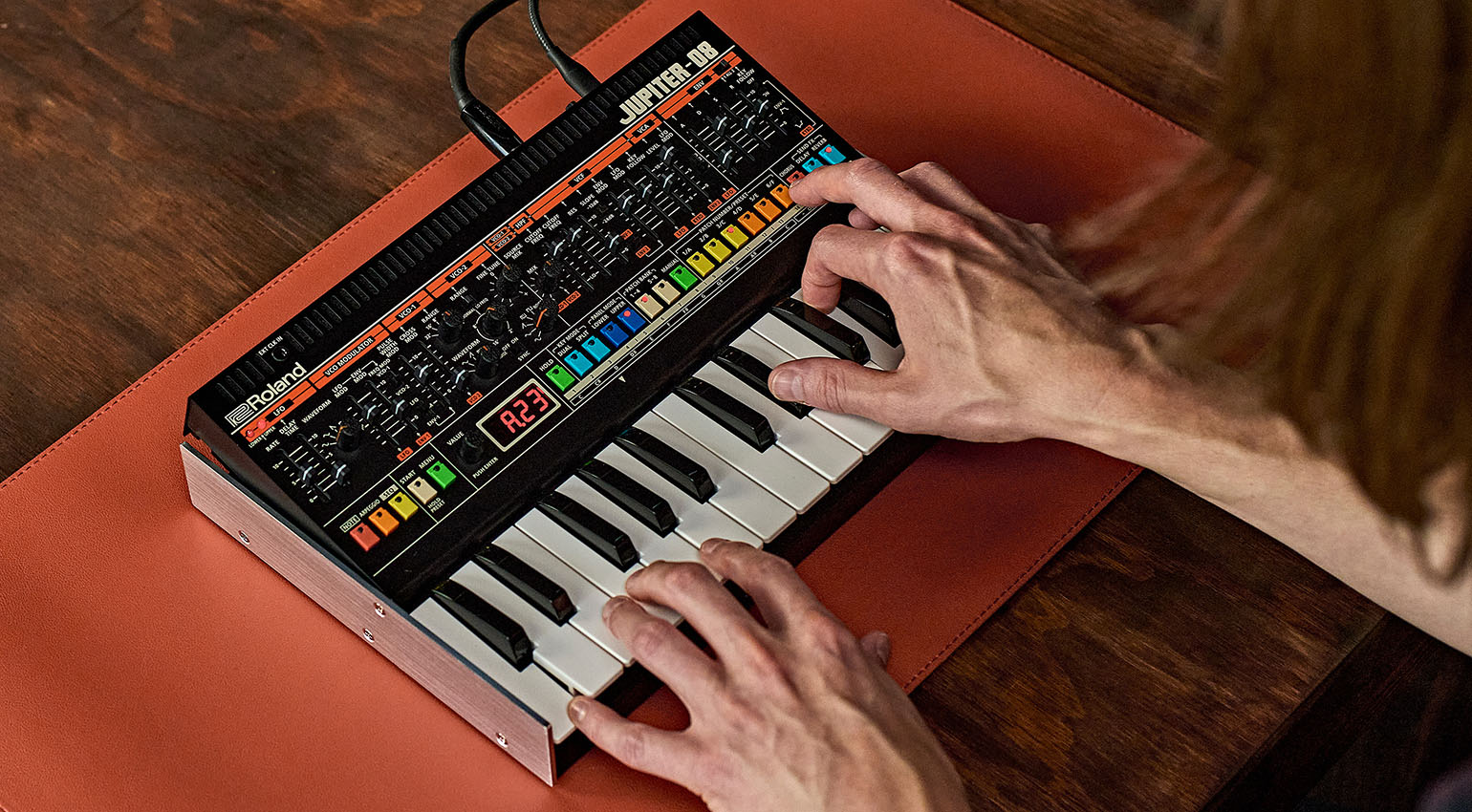
What immediately meets the eye, however, is that the Jupiter-08 looks much more like its famous predecessor than the JP-08. The two touch strips on the left side of the panel have been removed, which gave Roland the space to arrange the oscillators, mixer, filter, LFO, and envelopes side by side just like on the original—the one exception being that the envelopes share a single set of controls. The classic color scheme of the buttons is also much more Jupiter-like than on the JP-08. The small LED display has gained two additional digits and is now accompanied by a push encoder.
What’s also new is that for the first time in the Boutique series, the K-25m keyboard dock is now included. What’s more, Roland has also fitted it with stylish silver aluminum side panels exclusive to the Jupiter-08. Though introduced at the same time, the n/vision wavetable synth comes with a different version of the K-25m keyboard.
The synth can be used with or without the keyboard dock. Without it, it becomes an even more compact desktop synth. Even if you’re not planning to use the keys—which, admittedly, are nothing to write home about—the K-25m is still quite useful, as it allows you to position the panel at an angle. You can also do that with the optional DK-01 dock, which doesn’t have any keys.
The box also includes a printed quick start guide, which is extremely brief and covers only the very first steps. The complete user manual is available for download.
Connectivity
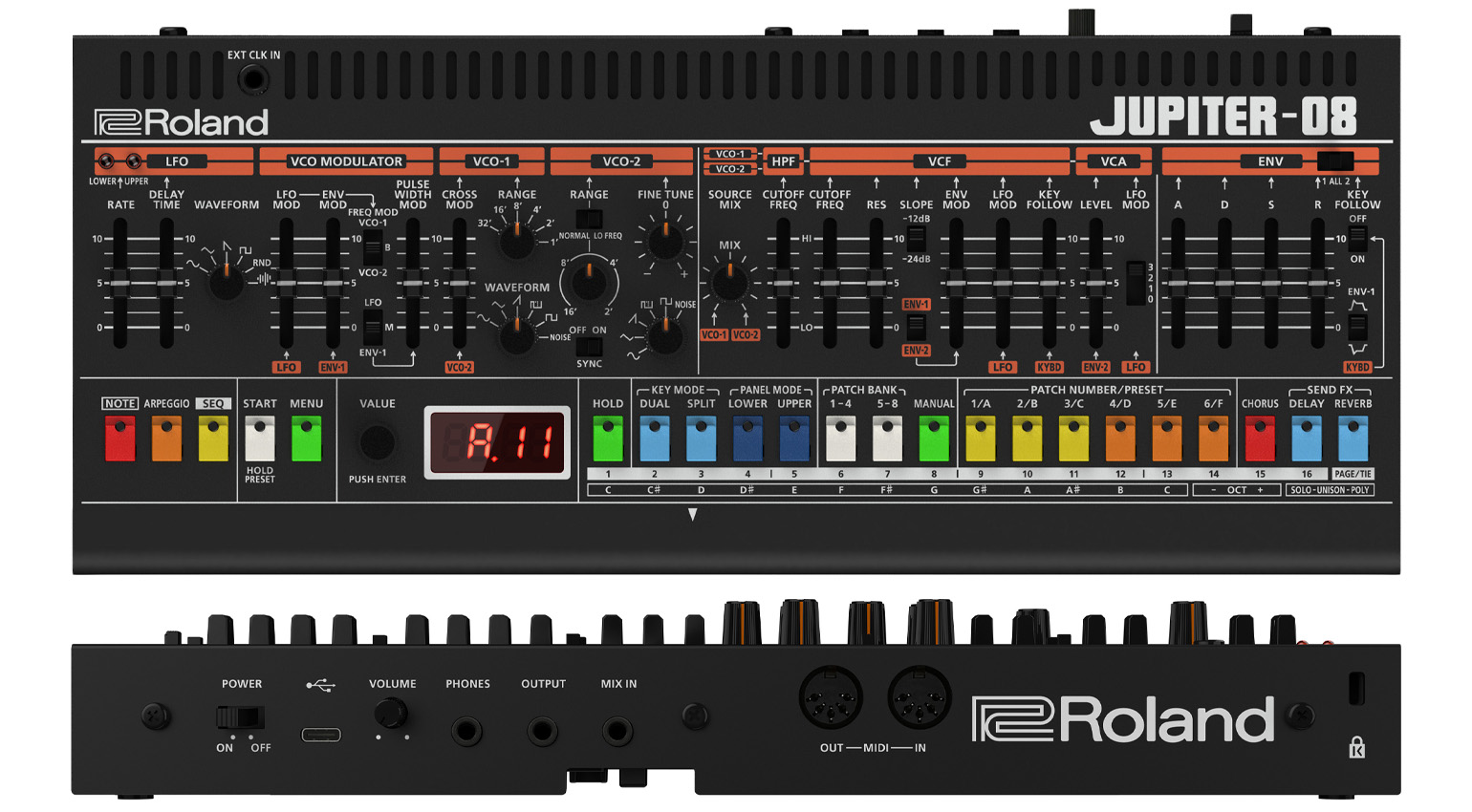
On the back, the Jupiter-08 is almost identical to its 11-year-old sibling—with one notable exception. In line with other new-generation Boutique synths such as the JD-08 and JX-08, the outdated micro-USB connector from the first series has been replaced by a USB-C port for both MIDI and audio. Unfortunately, connecting the synth to a computer requires a driver (even on a Mac), which wasn’t yet available to me at the time of testing, so I wasn’t able to test this.
Another very welcome new addition is a clock input, which allows you to sync the Jupiter-08 to analog timekeepers such as sequencers, drum machines, or modular systems. Otherwise, everything remains the same: The Jupiter-08 has headphone and line outputs, a mix input (all on 1/8” mini-jacks), a small volume control, MIDI In/Out, and a power switch.
Like the other members of the Boutique family, it also comes with a small built-in speaker on the bottom. To me, this feels like a nice little gimmick for collectors who like to take the synth from its shelf every now and then to play a few notes. Anyone who actually wants to make music with it, however, will certainly prefer using the line output.
Power is supplied via USB-C. Alternatively, the synth can run on a pair of AA batteries (included). When powered via USB, the K-25m is powered by the synth. In battery mode, the keyboard requires its own set of batteries.
Roland Jupiter-08: More Polyphony, Built-in Effects
The Jupiter-8 synthesis architecture requires no introduction, so I’ll spare you a lengthy description. In a nutshell, the Jupiter-08 is almost identical to the famous original in terms of available oscillators, filters, envelopes and such, with a few subtle additions. What I found interesting is that it isn’t 100% identical to any of Roland’s previous Jupiter-8 emulations. That it’s different from the old ACB model doesn’t come as a surprise, but it’s also not exactly the same as the newer model found in the ZEN-Core synths (Jupiter-X/Xm). Apparently, Roland has developed a new version of its in-house Jupiter emulation specifically for the Jupiter-08.
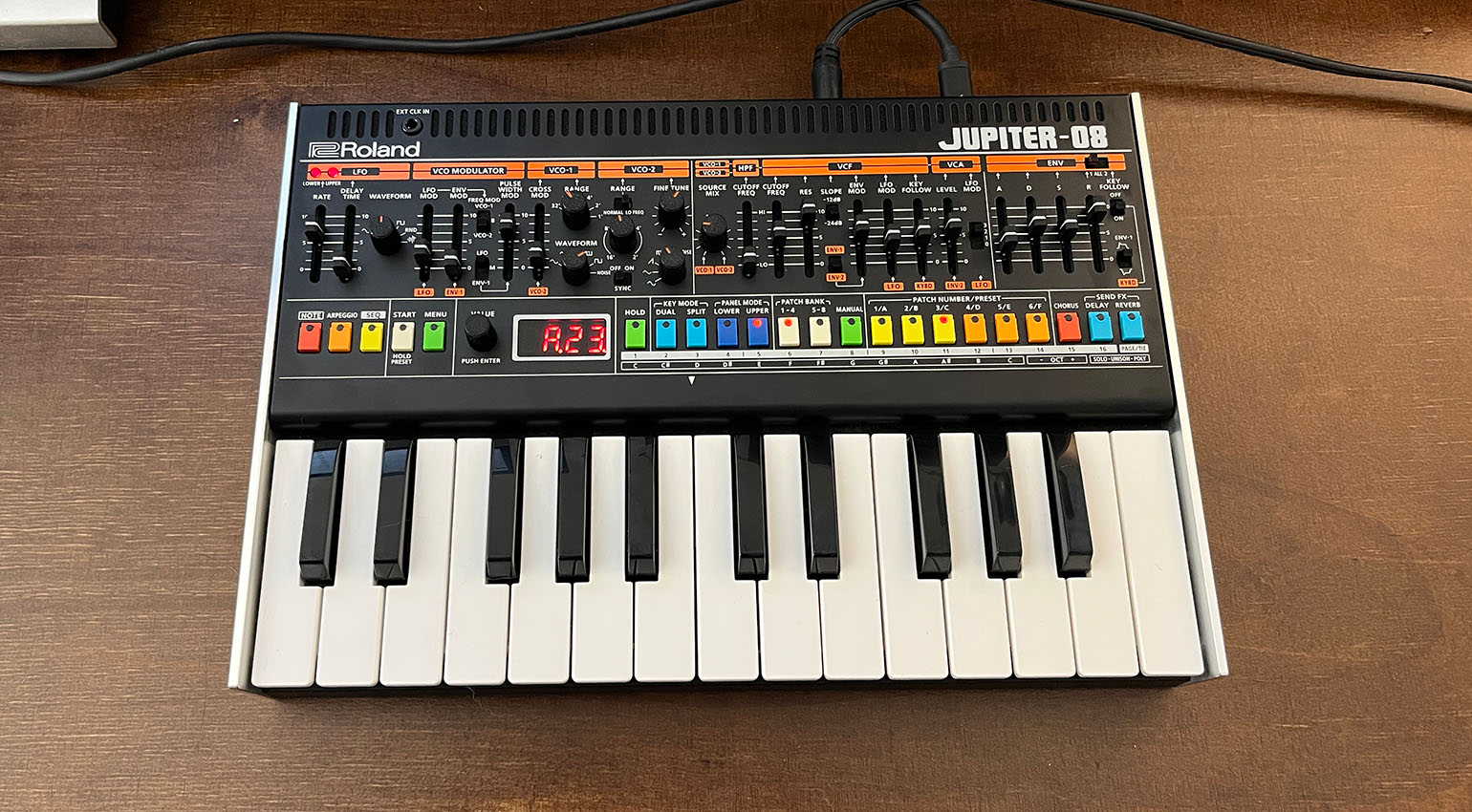
The original and the previous emulations (ACB and ZEN-Core) all featured certain differences between VCO1 and VCO2 in terms of available waveforms. In the Jupiter-08, both oscillators now share an identical set of waveforms. In addition to triangle, saw, square, and variable pulse, both can also produce sine and noise. As with the original, VCO2 can also be used as an LFO. Speaking of which, the dedicated LFO has also gained additional waveforms (triangle and “Chaos”).
Compared to the severely limited predecessor, the polyphony has been expanded to a generous 32 voices. On the four-voice JP-08, the bi-timbral layout with upper and lower parts for splits and layers was rather pointless; now it makes a lot of sense and is actually usable. If you want the authentic Jupiter feel, you can limit the synth to the eight voices of the original, though I fail to see why anyone would want to deliberately limit themselves in such a way.
Roland’s emulations of its analog classics have gained an excellent reputation for their authentic sound, and the Jupiter-08 is no exception. A quick scan through the presets reveals a wealth of classic Jupiter tones. Like the original, the synth really shines on strings, pads, punchy brass sounds, and basses. Thanks to the additional waveforms and the built-in effects, however, the palette extends well beyond the traditional Jupiter repertoire, and the synth surprises with some experimental timbres that one wouldn’t typically associate with a JP-8.
In addition to delay and reverb (the latter featuring the popular Shimmer effect), the Jupiter-08 offers 17 additional effects that can be accessed via the Chorus button. Here you’ll find various chorus variations (including emulations of several classics from the Roland catalog), as well as additional delays, distortion, a bitcrusher, two phasers, a versatile filter, and two pitch shifters. Although adjusting the effect settings via the menu isn’t particularly intuitive, this is still a very welcome addition.
Another new feature is the ability to deliberately let the synth ‘age’. The Condition parameter lets you dial in how ‘old’ or ‘analog’ you want the Jupiter-08 to sound. You can choose anything between an emulation of a brand-new off-the-shelf Jupiter-8 and a worn-out barn find. Very nice!
As expected, the Jupiter-08 sounds very good and offers some welcome enhancements. However, I’ll admit that it didn’t give me goosebumps, either. Despite the colorful buttons and virtual aging, it’s still no match for the sound of the original’s 16 VCOs kicking in simultaneously.
Is ‘True to the Original’ Always Better?
In a way, the Jupiter-08 is a synth of contradictions. On the one hand, Roland has added some features that weren’t present in the original (e.g., expanded polyphony, new waveforms, effects, etc.). However, other things that would certainly have made the synth more useful in a modern context were omitted in favor of staying true to the original. I’ll admit that this left me scratching my head a few times. Here are some examples.
In addition to monophonic and polyphonic modes, the Jupiter-08 features Unison. Unfortunately, however, Roland omitted a Detune parameter. So while you can layer plenty of oscillators, you can’t detune them against one another—except via the Condition function, which then also adds a whole host of other analog ‘imperfections’. I believe this is a missed opportunity. With Detune and perhaps even Spread, the Jupiter-08 would’ve had the potential for extremely wide and fat sounds—without feeling any less like a Jupiter.
What’s even more mind-boggling, however, is that the synth does not respond to velocity—not even via MIDI! When we asked Roland about this, the company confirmed that this decision was made in order to stay true to the original. In any modern production environment, however, this is a rather significant shortcoming. Even the MKS-80 from the 1980s (the analog rack version of the Jupiter-8) already supported velocity, not to mention every modern emulation I know (including the JP-08!). And it certainly doesn’t feel like blasphemy in those synths. Without velocity, the Jupiter-08 simply lacks a very important means of expression.
This decision seems even stranger because the Jupiter-08 does, in fact, respond to aftertouch, which the original didn’t have either. And when you realize that the included K-25m keyboard outputs velocity but not aftertouch (i.e., exactly the opposite of the synth it comes with), then it all just doesn’t add up anymore. Incidentally, the built-in sequencer also supports velocity, but the sound engine does not. I don’t know about you, but to me, this doesn’t make much sense.
Another missed opportunity is the lack of both MIDI and key sync for the LFO. Once again, Roland told us that this was done to preserve the spirit of the original. But it certainly wouldn’t have hurt anyone if the LFO could now run in sync. They’ve given it additional waveforms—why not sync?
Perhaps Roland can address these issues with a firmware update. Until then, unfortunately, these remain rather significant weaknesses—especially the lack of velocity.
Polyphonic Sequencer
While the JP-08 had a sequencer, it was quite limited, offering only 16 steps and a single track. The new Jupiter-08, on the other hand, features a much more capable sequencer with two tracks for the upper and lower parts and up to 64 steps per pattern. It’s also polyphonic and supports up to eight notes per step. In a synth whose traditional strongholds include massive chord sounds, this is of course a very welcome addition.
The sequencer offers step and real-time recording modes. When no K-25m or other keyboard is connected, you can use the colorful buttons to enter notes in both modes. What’s more, the real-time mode also lets you record the movements of the controls (motion recording). Very nice!
In addition, the sequencer allows you to set the velocity and gate time per step (even though the internal sound engine doesn’t support velocity). Additional settings such as playback direction and shuffle (swing) are available via the menu, as is a random function. All in all, the sequencer offers the features typically expected today, even if it isn’t particularly intuitive to use.
Ease of Use
Which brings us to a point that sometimes nearly drove me to despair. The fact that the Jupiter-08 offers significantly more features than its predecessor also means there are significantly more things to adjust. For anything beyond simply tweaking the sounds, you have to navigate to the menu—which is quite an ordeal every time.
Despite now having four digits, the small LED display cannot display parameter names in plain text. Instead, menu items are displayed using abbreviations that are sometimes absurdly cryptic. Without constantly consulting the PDF manual, I found the menu nearly impossible to navigate. Normally, I’m a fan of learning by doing. In this case, however, it was a rather frustrating experience. A higher-resolution LCD of the same size could work wonders here, but of course it wouldn’t look as ‘vintage’ or ‘authentic’.
I really hope that Roland will follow up with a software editor that solves this problem. If not, Momo Müller will surely be on hand soon to take care of it for us.
Roland Jupiter-08: Conclusion
The Roland Jupiter-08 may not be the analog Jupiter reissue that many had hoped for. Compared to its predecessor from the first Boutique series, however, it’s still a big step forward. Compared to the older JP-08, the new model offers significantly expanded polyphony, an improved sound engine, a polyphonic step sequencer, and a decent selection of built-in effects.
Nevertheless, it didn’t fully win me over. There are simply too many inconsistencies, of which the lack of velocity support is only the most serious. The rather cumbersome menu diving also takes away from the experience. In my opinion, anyone looking for a synth to make music with would be better off with the Jupiter-X/Xm.
The Jupiter-08 looks very cute and is a significant improvement over its predecessor. Ultimately, though, I see it more as a display piece that you’d buy for nostalgic reasons. Roland’s official product announcement lists “synth collectors, electronic musicians, producers, and performers” as the target audience—in that order. Collectors won’t be bothered by the price either, even though it’s significantly higher than that of the previous Boutique synths.
Roland Jupiter-08: Pros and Cons
Pros
- Convincing digital emulation of the Jupiter-8 sound
- Virtual Condition parameter
- 32 voices of polyphony
- Bitimbral architecture
- Polyphonic step sequencer with motion recording
- Good effects
- Integrated USB-C audio interface
Cons
- No velocity (not even via MIDI)
- Very cumbersome menu navigation
- No detune in unison mode, no LFO clock sync
- USB connection requires a driver (even on a Mac)
- Significantly higher price than previous Boutique synthesizers
Price and Availability
The Roland Jupiter-08 is now available from our affiliate partners Thomann* and Sweetwater*.
More Information
*This post contains affiliate links and/or widgets. When you buy a product via our affiliate partner, we receive a small commission that helps support what we do. Don’t worry, you pay the same price. Thanks for your support!
The post Roland Jupiter-08 Review: Second Time’s A Charm? appeared first on gearnews.com.